Other articles

  1. Timeline of Major Script Groups

    Timeline of Major Script Groups

    It's UN International Literacy Day!

    This timeline shows a very compressed history of writing, organized into major groups of scripts.
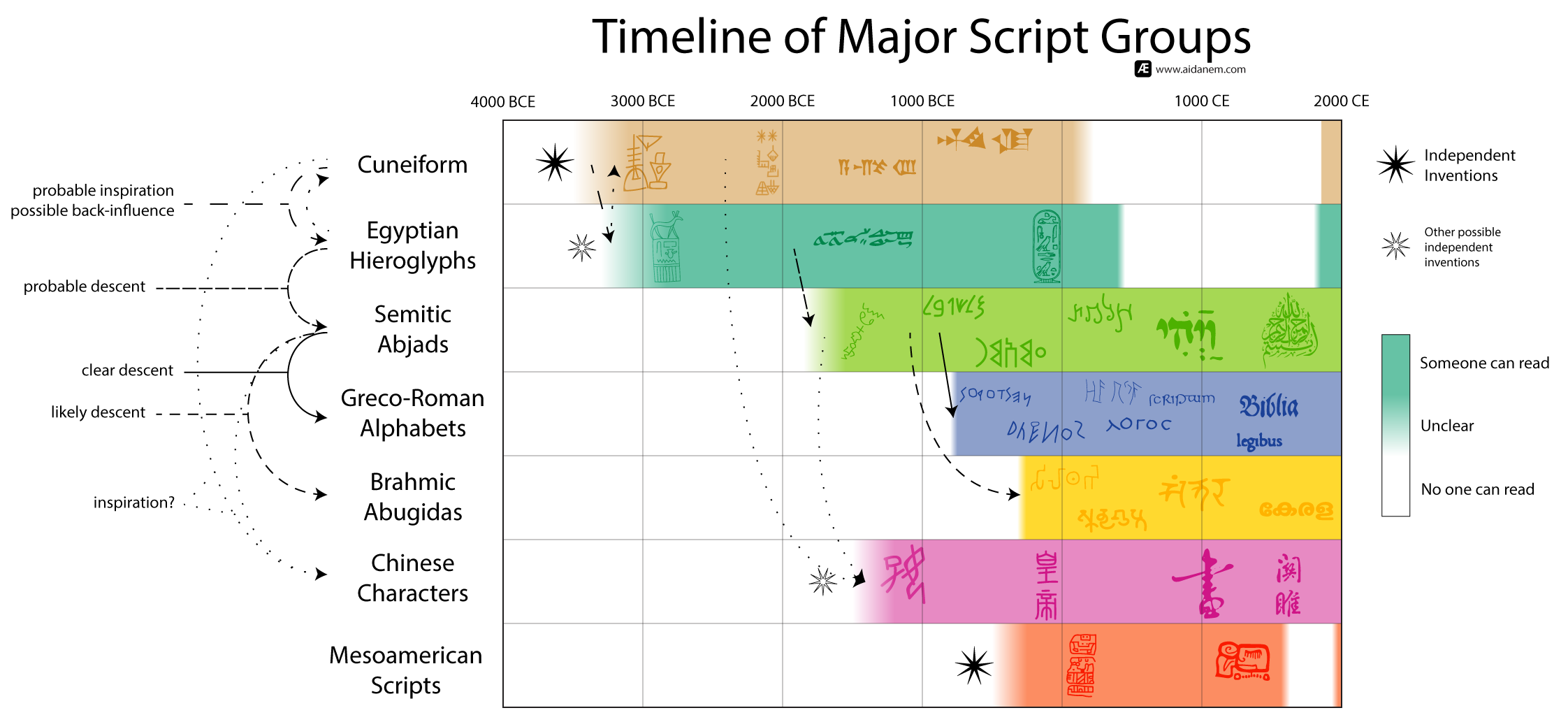
    Chart showing the period of usage for each of 7 major script groups:
• Cuneiform: 3500 BCE to 100 CE, and then 1850-2025 CE (deciphered)
• Egyptian Hieroglyphs: 3350 BCE to 450 CE, and then 1840-2025 CE (deciphered)
• Semitic Abjads: 1850 BCE to 2025 CE
• Greco-Roman Alphabets: 770 BCE to 2025 CE
• Brahmic Scripts: 320 BCE to 2025 CE
• Chinese Characters: 1300 BCE to 2025 CE
• Mesoamerican Scripts: 500 BCE to 1630 CE, and then 1960-2025 (deciphered)
• Embedded in the chart are images of the examples described below

    Independent Invention

    While many writing systems have been invented over the millennia, very few of them were ever created completely from scratch by people who …

    read more
  2. Kalevakirjat

    (Tegurala introduction: I have a D&D setting I have developed, which I call Tegurala. When I started working on it, I decided to use real world languages for the fantasy languages, for naming language consistency without having to create a bunch of new ConLangs. Giants use Uralic languages)

    The …

    read more
  3. Word Family - Camel

    June theme: Domestic Animals 🐕

    Full Text

    • West Semitic *gamal- camel
      • Central Semitic
        • Arabic جمل gámal jámal camel
          • Maltese ġemel camel
          • Swahili ngamia camel
        • Northwest Semitic
          • Aramaic 𐡂𐡌𐡋𐡀 / גמלא gamlā’ camel
            • Classical Syriac ܓܡܠܐ gamlā’ camel
          • Canaanite
            • Hebrew גמל gamal camel
            • Phoenician 𐤂𐤌𐤋 gml camel
              • Classical Greek κάμηλος kámēlos camel
                • Greek …
    read more
  4. Word Family - Cow

    June theme: Domestic Animals 🐕

    Introduction

    Proto-Indo-European has *gʷṓws: "cow, cattle" and possible *woḱéh₂: "(female) cow".

    And some other likely descendants of (the same?) Central Asian substrate words for "cattle": Sino-Tibetan *ŋwa: "cattle, ox", West Semitic *baḳar-: "cattle, ox"

    Teaser

    cow, butter, botany, beef, vaccine

    Full Text

    • ? Central Asian substrate?, a …
    read more
  5. Word Family - Egypt

    December theme: Pre-Classical Mediterranean 🏝

    Introduction

    Tying Minoan (Cretan) Phaistos and Greek Hephaestus in to this family is speculative, but not as wild a reach as it first looks like.

    Hephaestus and Phaistos, Crete:

    We usually represent the name as Hephaestus in the Roman alphabet, after Roman transliteration traditions, but (as …

    read more
  6. Tuʻara — Tengwar for Polynesian

    Tengwar for Te Reo

    This page describes a counter-factual in which the Tengwar writing system (from Tolkien's Middle-Earth) is instead developed by speakers of Polynesian languages and called Tuʻara.

    I developed it primarily for use in my D&D game. I …

    read more

social