December theme: Pre-Classical Mediterranean 🏝
Teaser
Europe, Maghreb, Arabia, Erebus
Full Text
-
Semitic *ʿrb *ġrb to depart, to set [1]
-
Central Semitic
-
Arabic غ ر ب ġ r b
- Arabic غرب ġaraba to depart, to withdraw, to set
- Arabic غرب ġaruba to be a stranger, to be strange, to be difficult to understand
-
Arabic غرب ġarb west
- Maltese għarb west
- Azerbaijani qərb west
- Persian غرب ġarb west
-
Ottoman Turkish غرب ġarb
- Turkish garp west
-
Northwest Semitic
-
Aramaic ערב / ܥܪܒ / 𐡏𐡓𐡁 ʿ-r-b
- Aramaic 𐡏𐡓𐡅𐡁𐡄 ʿrōbā sunset, evening, (Sabbath) eve
-
Aramaic ערבא ʿərāḇā sunset
- Classical Syriac ܥܪܒܐ ʿrāḇā sunset, eve
-
Canaanite
-
Hebrew ע־ר־ב ʿ-r-b
-
Hebrew ערב érev evening, night
- Yiddish ערבֿ erev eve
-
-
Phoenician 𐤏𐤓𐤁 ʿereb sunset, evening
-
Archaic Greek *Eurōpā [2]
-
Homeric Greek Ευρώπη Eurṓpē Western shore of the Aegean, mainland Greece (as opposed to Pelopennese or the islands)
-
Classical Greek Εὐρώπη Eurṓpē Land north of the Mediterranean Sea and west of the Aegean and Black Seas, Europe, Europa
- Greek Ευρώπη Evrópi Europe, Europa
-
-
Doric Greek Ευρώπα Eurṓpa
-
Latin Europa
-
French Europe
-
English Europe
- Hindi यूरोप yūrop
- Korean 유럽 Yureop
- English Proto-Indo-European
-
- Italian Europa
-
Portuguese Europa
- Japanese ヨーロッパ Yōroppa
- Spanish Europa
- Arabic أوروبا ʾūrubbā Europe
-
Literary Chinese 歐羅巴 Europa, Europe (archaic)
-
Mandarin 歐羅巴 Ōuluóbā
- Mandarin 歐洲 Ōuzhōu Europe [3]
-
- English Europa
- German Europa
-
- Russian Европа Jevropa Europe
-
Ukrainian Європа Jevropa Europe
-
Ukrainian Євромайдан Jevromajdán Euromaidan
- English Euromaidan
-
French europium
- English europium
- Translingual Eu
-
-
-
-
-
-
-
Central Semitic *ma-ʿrb *ma-ġrb place of sunset, western place, the west locative
-
Arabic مَغْرِب maḡrib place or time of sunset, west, evening
-
Arabic الْمَغْرِب al-maḡrib The Maghreb, Morocco
- English Maghreb
-
-
-
Northwest Semitic
-
Aramaic מערבא ma-ʿrba west
- Classical Syriac ܡܰܥܪܒܐ ma‑ʿrḇā west, occident, sunset, western sky, west wind
-
Canaanite
- Hebrew מערב ma‑ārov the west, occident
-
-
Central Semitic *ʿrb? surety, pledge (money before you leave)?
- Arabic عراب ʿarrāb
-
Aramaic ערב / ܥܪܒ / 𐡏𐡓𐡁 ʿăraḇ to vouch for
- Classical Syriac ܥܪܒܐ ʿarrāḇā sponsor, guarantor, godfather, groomsman
-
Northwest Semitic
-
Canaanite
- Hebrew ערבון erabon guarantee
-
Phoenician
-
Punic *ʿarb
-
Latin arbiter
-
Western Romance
-
French arbitre mediator, arbitrator, referee
- English arbiter
- Italian arbitro referee, umpire, arbitrator
- Spanish árbitro referee
-
-
-
-
Classical Greek ἀρραβών arrabōn pledge, surety, deposit, down payment
- Greek αρραβώνας arravónas engagement, betrothal, deposit, earnest money
-
Latin arrhabō
-
Latin arrha
-
Western Romance
-
French arrhes down payment, deposit
- English earnest [4]
-
-
-
-
-
-
-
East Semitic
-
Akkadian 𒌅 erēbu to go down, to set, to enter
-
Akkadian Ereb night, sunset, the west in contrast to sunrise/east: Asu (Asia?
-
Arabic عرب ʿarab Arab [5]
-
Aramaic
- Old Persian 𐎠𐎼𐎲𐎠𐎹 Arabāya Arabia
-
Classical Greek Ἄραψ Áraps Arab, Arabian
- Greek Άραβας Áravas Arab
-
Classical Greek Ἀραβία Arabíā Arabia
- Greek Αραβία Aravía Arabia
-
Latin Arabia Arabia
- English Arabia
- French Arabie
- Italian Arabia
- Spanish Arabia
- Yiddish אַראַביע arabye
-
Classical Greek Ἀραβικός Arabikós Arabic, Arab
-
Latin arabicus Arabic
- English Arabic
-
- Chinese 阿拉伯 Ālābó Arabia
- Hebrew עֲרָב aráv Arabia
-
Persian عرب 'arab Arab, Arabian
-
Persian عربستان 'arabestân Arabia
- Turkish Arabistan Arabia
-
- Somali Carabiya Arabia
- Swahili Uarabuni Arabia
-
Arabic عربية / العربية ʾarabiyya al-ʾarabiyya Arab (f.), Arabic
- Translingual ara ISO 639 code for Arabic
-
-
-
-
-
Proto-Indo-European *h₁régʷos darkness [6]
-
Old Armenian երեկ erek evening, west, evening star (Venus)
-
Old Armenian երեկոյ erekoy evening
- Armenian երեկո ereko evening
-
Old Armenian ցերեկ cʿerek by day, day, daytime lit. "up until evening"
- Armenian ցերեկ cʿerek day, daytime [7]
-
Old Armenian երէկ erēk yesterday
- Armenian երեկ erek yesterday
-
-
Germanic *rekwaz darkness
-
East Germanic
- Gothic 𐍂𐌹𐌵𐌹𐍃 riqis darkness
-
North Germanic
-
Old Norse røkkr / røkr twilight
-
Old West Norse
- Icelandic rökkur twilight
-
-
-
-
Hellenic
-
Classical Greek Ἔρεβος Érebos primordial divinity of darkness
-
Latin Erebus
- English Erebus
-
-
-
Indo-Iranian *Hráǰas
-
Indo-Aryan *Hráȷ́as
- Sanskrit 𑀭𑀚𑀂 रजः rájaḥ darkness, dust, space between heaven and earth
-
-
Proto-Indo-European *h₁regʷesyéti to be getting dark
-
Germanic *rikwizjaną to get dark
-
East Germanic
- Gothic 𐍂𐌹𐌵𐌹𐌶𐌾𐌰𐌽 riqizjan to become dark, to darken
-
-
Indo-Iranian *Hraǰasyáti
-
Indo-Aryan *Hraȷ́asyáti
- Sanskrit 𑀭𑀚𑀲𑁆𑀬𑀢𑀺 rajasyáti to become dust, to be scattered
-
-
-
Proto-Indo-European *h₁rgʷsnos
-
Hellenic *erkʷʰnos
-
Hellenic *orkʷʰnā secondary o-grade
- Classical Greek ὄρφνη órphnē night, darkness
-
-
-
Proto-Indo-European *h₁régʷenih₂
-
Indo-Iranian
-
Indo-Aryan
- Sanskrit 𑀭𑀚𑀦𑀻 रजनी rájanī night
-
-
-
-
Visual
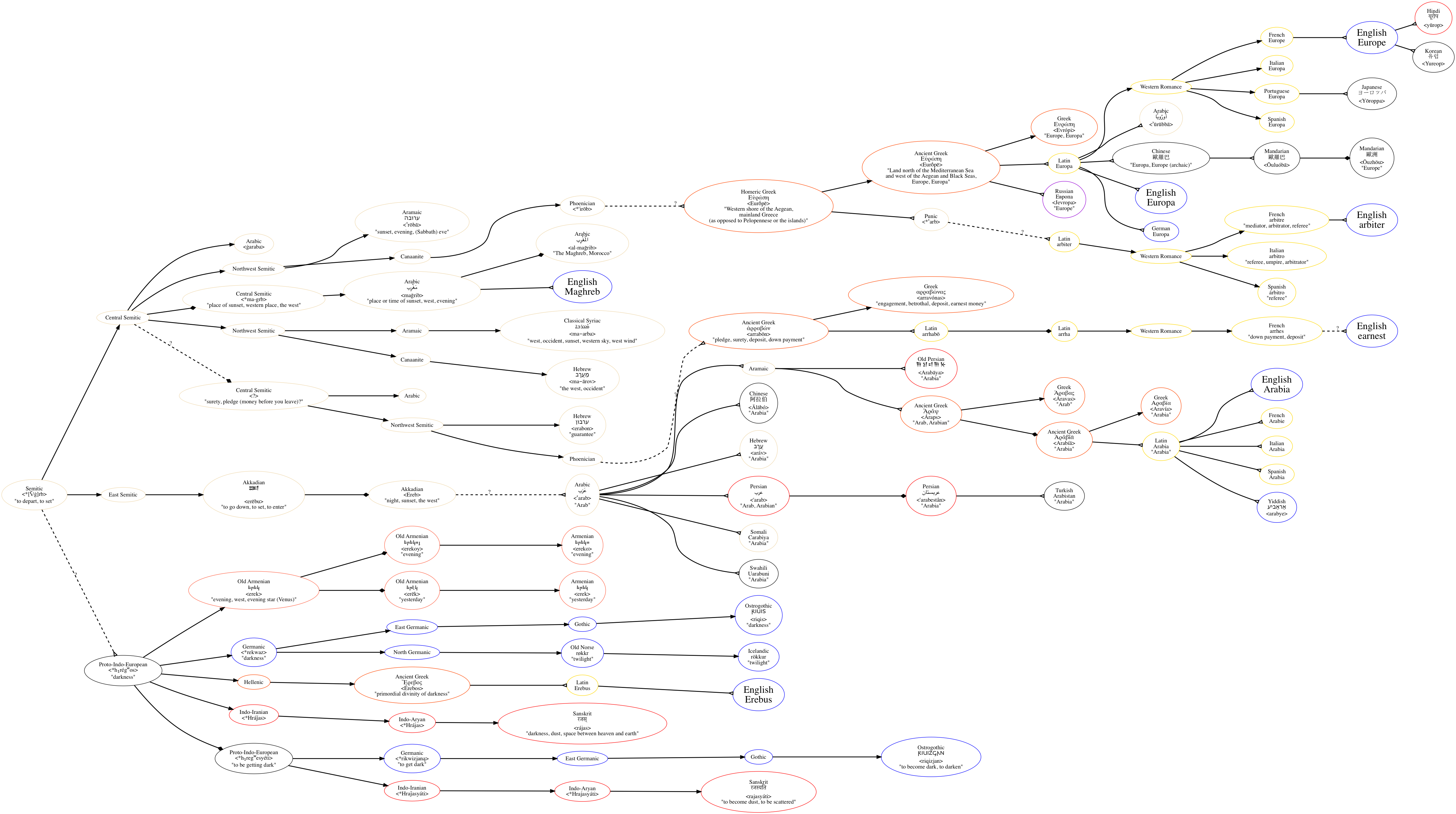
Collected English words
Europe, Proto-Indo-European, Europa, europium, Eu, Maghreb, arbiter, earnest, Arabia, Arabic, ara, Erebus, Euromaidan
Footnotes
-
^
The first consonant of the Semitic root is ambiguous. The Arabic form points to *ġ (/ɣ/), but in that case Akkadian should have ḫ (/χ/); instead the Akkadian has e-coloring and no consonant, which should come from Semitic *ʕ. Aramaic, Hebrew, and Phoenician forms can't help answer the question, because *ġ and *ʕ merged in Northwest Semitic.
If the Proto-Indo-European *h₁régʷos is related, IE *h₁ usually corresponds to Semitic *ʔ, h₂ is the usual correspondence to Semitic *ʕ.
-
^
Εὐρώπη`=grc-Grek Eurṓpē (Archaic and Doric Eurōpā) is traditionally derived in Greek as "broad-face", the name of a mythological Phoenician princess abducted by Zeus and brought to Crete. This is almost certainly a folk-etymology of a non-Greek borrowing.
Phoenician ʿereb is a very likely candidate for what the Greeks folk-etymologized as Eurōpā, given that (1) the mythological Europa is described as a Phoenician princess, (2) phoentically similar to Eurōpā is Phoenician 𐤏𐤓𐤁 ʿereb: "sunset, evening" probably either also meant "west" or had a related word *m-ʿrb that did, and (3) Greece is to the west of Phoenicia.
-
^
Modern Mandarian 歐洲 Ōuzhōu is formed by abbreviation of 歐羅巴 Ōuluóbā to 歐 and then suffixing 洲 zhōu: "continent". The same process is used to create the modern forms of the other continent names, such as Yàzhōu: "Asia" from Yàxìyà; or Fēizhōu: "Africa" from Āfēilìjiā.
-
^
English earnest as in "down payment, surety", of uncertain etymology, but probably a mixture of French arrhes: "down payment, surety" and Old English eornost: "sincerity, earnestness".
-
^
Arabian self-designation is of uncertain origin. It is the same triconsonantal root in some but not all Semitic languages, but does not follow the normal rules for which languages merge [ɣ] and [ʕ]. The most likely explanation is that it is a doublet borrowing of the root for "west" from Eastern Semitic.
Prof. Ahmad Al-Jallad (@Safaitic) once said:
"Where does the term ‘Arab‘ come from? It is impossible to know for sure, but there are many theories. A popular one relates it to the root ‘-b-r, which gives the name of the Hebrew language. The best explanation IMO is a derivation from the root ġ-r-b ‘west’ > ‘westerners’.
"This makes sense geographically. The name wouldn’t have originated in Arabic; it was a term used by outsiders to refer to the land/people/language, comparable to the term Amorite Mar.tu ‘westerner’. But it must have been adopted by the people it referred to early on."
-
^
Since we know there are some borrowings from Semitic into Indo-European, the similarity between Semitic *ʿrb: "sunset" and Proto-Indo-European *h₁régʷos bears a second look. There are no attested words coming from any morphological form other than *h₁régʷos (and secondary derivations from there), which could point to a borrowed word that never had a root form, that was secondarily fit to an adjective morphology.
On the other hand, the forms don't match up quite well enough to prove a connection. PIE *h₁ usually corresponds to Semitic *ʔ. Similarly Semitic *b and PIE *gʷ are close neighbors—both voiced stops with a labial component—but not an expected correspondence. *gʷ to *b would be a normal and expected distortion in borrowing, but *b to *gʷ is much less expected.
-
^
Armenian cʿerek : "day" replaced Old Armenian տիւ tiw: "day" from Proto-Indo-European *diwoh₁: "bright" (the same root as many other IE words for "day" Latin dies, Welsh dydd, Sanskrit दिन diná)