Teaser
mirror, admire, miracle, Miranda, smile
Full Text
-
Proto-Indo-European *smey- to laugh, to be glad
-
Proto-Indo-European *ḱóm smey- smile with, smile at
-
Proto-Indo-European *ḱóm smis
-
Italic *komsmis
-
Latin cōmis courteous, kind, polite, gracious, elegant
-
Latin cōmitās / cōmitātem courtesy, kindness, politeness, elegance [4]
- English comity
-
-
-
-
-
Proto-Indo-European *sméyeti primary verb
-
Balto-Slavic
-
Baltic
-
East Baltic
- Latvian smieties to laugh
-
-
Slavic *smьjàti *smьjàti sę to laugh
-
East Slavic смиꙗти / смѣꙗти / смѣꙗтисѧ smijati smějati smějatisja
- Russian смеяться smejátʹsja to laugh, to mock
- Ukrainian сміятися smijatysja to laugh
-
South Slavic
- Old Church Slavonic смиꙗти smijati
- Bulgarian смея се smeja se to laugh, to laugh at
- Serbo-Croatian смејати / smejati / смијати / smijati to laugh
-
West Slavic
- Czech smát / smát se to laugh
- Polish śmiaćsię to laugh
-
-
-
Indo-Iranian *smáyatay
-
Indo-Aryan *smáyatay
- Sanskrit स्मयते smayate to smile, to laugh, to blush
-
-
Tocharian
- Arshian smimāṃ laughing
- Kushean smiyäṃ to laugh
-
-
Proto-Indo-European *sméyros smiling, happy adjective
-
Indo-Iranian *smáyras
-
Indo-Aryan *smáyras
- Sanskrit स्मेरः sméraḥ smiling, proud, happy, friendly, blooming, expanded, manifested
-
-
Italic *smeiros
-
Latin mīrus wonderful, amazing
-
Vulgar Latin *miricula diminutive substantive
-
Western Romance
-
Occitan Mirèlha cf. aurelha from Latin auricula
- French Mireille
-
-
-
Latin mīrārī to marvel at, to admire, to wonder at
-
Latin admīrārī to wonder at, to admire
-
Old French amirer
-
Middle French admirer
- French admirer admire
-
Middle English admyren
- English admire
-
- Italian ammirare to admire, to appreciate
- Spanish admirar to admire, to be amazed
-
-
Central Romance
- Italian mirare to aim, to sight, to point, to admire, to comtemplate
-
Western Romance
-
Old French mirer
-
Middle French
-
French mirer to look at
-
French mirage mirage
- English mirage
-
-
-
Old French mireor mirror
-
Middle French miroir
- French miroir mirror instrumental: ~"looking tool/place"
-
Middle French mirour / merrour / mirowr mirror, example
- English mirror
-
-
- Spanish mirar to look, to watch, to face (in a direction)
-
-
Latin mīrāculum object of wonder
-
Eastern Romance
- Aromanian mirachi / mirache desire, wish, passion, regret
-
Western Romance
-
Old Spanish miraglo
- Spanish milagro miracle partially re-Latinized
-
-
Old French miracle
-
Middle French miracle
- French miracle miracle
-
Middle English miracle
- English miracle
-
Middle Dutch mirakele
- Dutch mirakel miracle
-
- Italian miracolo miracle, marvel, wonder
-
-
Latin mīrābilis
-
Central Romance
- Italian meraviglia wonder, marvel, astonishment, surprise
-
Western Romance
-
Old French merveille
-
Middle French
- French merveille wonder, marvel
-
Middle English merveile wonder, marvel
- English marvel
-
-
Old Provençal
- Catalan meravella wonder, marvel, morning glory
- Spanish maravilla wonder, marvel, sunflower, marigold
-
Old Spanish maravija
- Spanish maravilla wonder, marvel, sunflower, marigold
-
-
-
Latin mīrandus which is to be wondered at, outlook, watchtower
-
English Miranda [2]
- Translingual Miranda Moon of Uranus
-
-
-
-
-
Proto-Indo-European *smilós *smirós laughter?, happy person?
-
Proto-Indo-European *smiloyéti? *smiroyéti? denominative: "to be a happy person?"
-
Germanic *smilāną to smile
-
North Germanic
-
Old Norse *smíla
-
Old Danish smile
- Danish smile to smile
- Middle English smilen to smile
- English smile
-
-
-
West Germanic *smilēn *smīlēn
-
Old High German smielen
-
Middle High German smielen
-
Middle Low German *smîlen *smielen
-
Old Danish smile
- Danish smile to smile
- Middle English smilen to smile
- English smile
- Low German smielen to smile
-
-
-
-
-
-
Germanic *smirāną [3]
-
West Germanic *smerēn to mock, deride
-
Old English smerian to deride, to scorn
-
Old English smercian to smirk
- English smirk
-
-
-
-
-
-
Visual
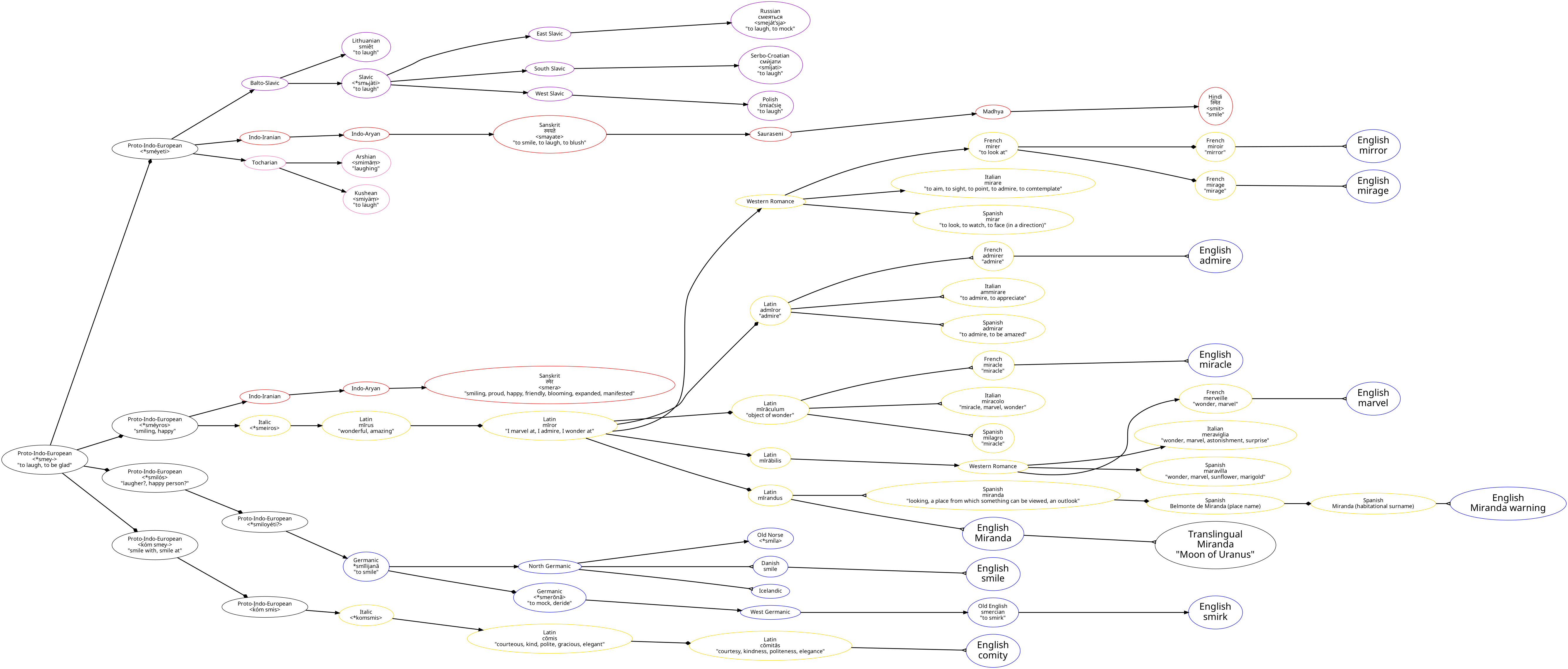
Collected English words
mirage, mirror, admire, miracle, marvel, Miranda warning, Miranda, Miranda, smile, smirk, comity
Footnotes
-
^
Belmonte de Miranda is just an example place name, one of many in Spanish, Portuguese, and Italian. The habitational surname comes from many of them.
-
^
Miranda as an English personal name is first used in Shakespeare's _The Tempest_. It is a notably characteristic of the character Miranda that she both wonders at, and is wondered at.
Miranda's most famous line is: "O wonder! How many goodly creatures are there here! How beauteous mankind is! O brave new world, That has such people in't.".
And when Ferdinand first sees her, he addresses her "O you wonder!", and since they are theoretically speaking Italian, he's effectively calling her by her actual name.
-
^
In many descendants, Germanic *smirāną: "to mock, deride" was merged into *smirwijaną: "to smear", from *smerwą: "grease, butter, fat".
-
^
Latin cōmis/cōmitās: "smile with"; not to be confused with comes/comitis: "go with"